















N5K-C5672UP - Cisco Nexus 5000 Series Switch


- $350.00 In Stock - Ships Worldwide Order by 2:00 PM ET for Overnight Shipping
-
Warranty: 90-day return/replacement
Click here to read our Return Policy for returns/replacements.
N5K-C5672UP
Free ground shipping within the
United States

Government, Federal & Education Procurement
We support quotes, POs, stock docs, and compliance invoicing.
Email: support@buyrouterswitch.com SAM.gov Registered Vendor CAGE Code : 23P86
overview
specifications
faqs
reviews
N5K-C5672UP Overview
Nexus 5672UP Chassis, 1RU, 32 p 10-Gbps SFP+, 16 Unified Ports, 6p 40G QSFP+ N5K-C5672UP
Overview
N5K-C5672UP Overview
Cisco Nexus 5672UP, Managed, L2/L3, 40 Gigabit Ethernet, Full duplex, Rack mounting, 1U
Cisco Nexus 5672UP switch (N5K-C5672UP) is a compact 1RU (1 Rack Unit), high-performance, low-latency 1/10/40-Gigabit Ethernet, Fibre Channel, and Fibre Channel over Ethernet (FCoE) switch. It runs the industry-leading Cisco NX-OS Software operating system, providing features and capabilities that are widely deployed.
Quick Specs
Figure 1 shows the appearance of N5K-C5672UP.

Product Code | N5K-C5672UP |
Performance | Layer 2 and 3 hardware forwarding at 1.44 Tbps; 1071 mpps (64-byte packets) |
Form factor | 1-rack unit |
Power Supplies | two 1+1 redundant, hot-swappable power supplies |
Fan Modules | 3 |
Airflow | supporting both port-side intake (red handle) and fan-side intake (blue handle) airflow options for flexible mounting |
10 GE | 48 ports |
40 GE | 6 true QSFP ports |
Ports | 48 fixed 1 Gigabit and 10 Gigabit Ethernet ports of which 16 ports can be unified ports (UP) |
10 and 40 Gbps FCoE | Yes |
Hardware VXLAN | Yes |
NVGRE capable | Yes |
Latency | 1 microsecond |
Physical (height x width x depth) | 1.75 x 17.3 x 30 in. (4.4 x 43.9 x 76.2 cm) |
Weight | 32 lb (2 power supplies) |
Product Details
Figure 2 shows the front panel of N5K-C5672UP.
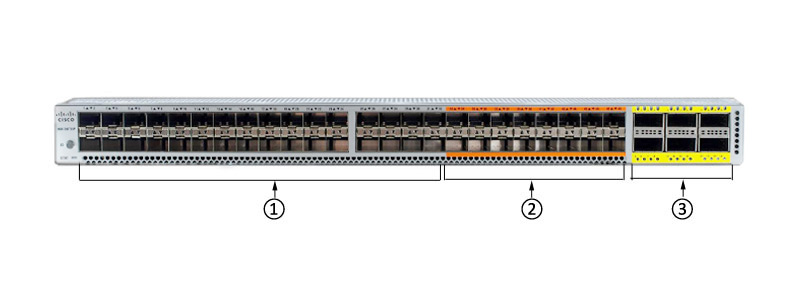
Note:
① | 1/10G Ethernet SFP+ ports |
② | 16 x UP ports |
③ | 6 x 40G QSFP ports |
Figure 3 shows the back panel of N5K-C5672UP.
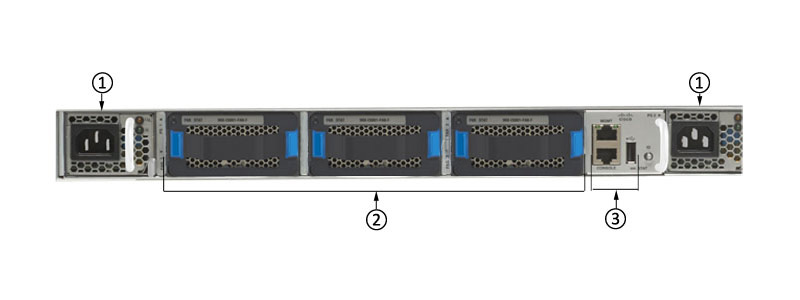
Note:
① | Power Supply 1+1 redundancy |
② | Fan Module 2+1 redundancy |
③ | Mgmto/Console/USB |
The Accessories
.
Category | Model | Description |
QSFP Transceiver and Optics | QSFP-40G-LR4 | QSFP 40GBASE-LR4 OTN Transceiver, LC, 10KM |
QSFP-4SFP10G-CU5M | QSFP to 4xSFP10G Passive Copper Splitter Cable, 5m | |
SFP Transceiver and Optics | SFP-10G-SR | 10GBASE-SR SFP Module |
SFP-H10GB-CU5M | 10GBASE-CU SFP+ Cable 5 Meter |
Compare to Similar Items
Product Code | N5K-C5672UP | N5K-C56128P |
Form factor | 1-rack unit | 2-rack unit |
Power Supplies | two 1+1 redundant, hot-swappable power supplies | four 2+2 redundant, hot-swappable power supplies |
Airflow | supporting both port-side intake (red handle) and fan-side intake (blue handle) airflow options for flexible mounting | supporting both port-side intake (red handle) and fan-side intake (blue handle) airflow options. |
Number of ports | Up to 1152 with FEX | 1152 with FEX |
10 GE | 48 ports | Up to 96 wire-rate ports |
40 GE | 6 true QSFP ports | Up to 8 QSFP ports |
Unified ports | 16 ports (Ethernet; FCoE; 2/4/8-gigabit FC) | Up to 48 ports (Ethernet; FCoE; 2/4/8-gigabit FC) |
10 and 40 Gbps FCoE | Yes | Yes |
Hardware VXLAN | Yes | Yes |
NVGRE capable | Yes | Yes |
Latency | 1 microsecond | 1 microsecond |
48 ports, 6 true QSFP ports, 16 ports (Ethernet; FCoE; 2/4/8-gigabit FC)
- Managed L2/L3
- Quality of Service (QoS) support
- Basic switching RJ-45 Ethernet ports quantity: 48 Console port: RJ-45
- 10G support
- 1U Rack mounting
Summary Description
Cisco Nexus N5K-C5672UP=, Managed, L2/L3, 10G Ethernet (100/1000/10000), Rack mounting, 1U
Need help with N5K-C5672UP?
Get pricing, availability, lead time, and compatible options from our team. Chat with us live or email support@buyrouterswitch.com
Specification
N5K-C5672UP Specification
N5K-C5672UP Specifications | |
Form factor | 1-rack unit |
Number of ports | Up to 1152 with FEX |
10 GE | 48 ports |
40 GE | 6 true QSFP ports |
Unified ports | 16 ports (Ethernet; FCoE; 2/4/8-gigabit FC) |
10 and 40 Gbps FCoE | Yes |
Hardware VXLAN | Yes |
NVGRE capable | Yes |
Latency | 1 microsecond |
Performance | ● Layer 2 and 3 hardware forwarding at 1.44 Tbps; 1071 mpps (64-byte packets) ● Support for up to 256,000 combined entries of MAC addresses and Address Resolution Protocol (ARP) entries ● Low latency of approximately 1 microsecond using cut-through forwarding for predictable, consistent traffic latency regardless of packet size, traffic pattern, or features enabled on 10 and 40 Gigabit Ethernet interfaces ● 25-MB buffer per 12 x 10 Gigabit Ethernet SFP+ interfaces ● Line-rate traffic throughput on all ports in Layer 2 and 3 mode |
Interfaces | ● 48 fixed 1/10 Gigabit Ethernet SFP+ ports with 16 of the 48 ports being unified, and 6 fixed 40 Gigabit Ethernet QSFP+ ports with 10 and 40 Gigabit Ethernet FCoE support on all respective ports and 2/4/8-Gbps Fibre Channel on all the unified ports ● Expansion module: 24 SFP+ unified ports plus 2 x 40 Gigabit Ethernet QSFP+ ports ● Conversion of 40 Gigabit Ethernet ports to 10 Gigabit Ethernet interfaces through QSFP+ breakout cable ● Fabric extension through the Cisco Nexus 2200 and 2300 platforms |
Layer 2 Features | ● Layer 2 switch ports and VLAN trunks ● IEEE 802.1Q VLAN encapsulation ● Support for up to 4000 VLANs ● Support for up to 4000 access control list (ACL) entries ● Rapid Per-VLAN Spanning Tree Plus (PVRST+) (IEEE 802.1w compatible) ● Multiple Spanning Tree Protocol (MSTP) (IEEE 802.1s): 64 instances ● Spanning Tree PortFast ● Spanning Tree root guard ● Spanning Tree Bridge Assurance ● Cisco EtherChannel technology (up to 16 ports per EtherChannel) ● Cisco vPC technology ● vPC configuration synchronization ● vPC shutdown ● Link Aggregation Control Protocol (LACP): IEEE 802.3ad ● Advanced port-channel hashing based on Layer 2, 3, and 4 information ● Jumbo frames on all ports (up to 9216 bytes) ● Pause frames (IEEE 802.3x) ● Storm control (unicast, multicast, and broadcast) ● Private VLANs ● Private VLAN over trunks (isolated and promiscuous) ● Private VLANs over vPC and EtherChannels ● VLAN remapping ● FabricPath ● EvPC and vPC+ with FabricPath ● Adapter FEX ● Data Center VM-FEX ● Support for up to 24 fabric extenders (Layer 2) with each Cisco Nexus 5672UP, 5672UP-16G, and 56128P Switch ● RDMA over Converged Ethernet (RoCE) using Data Center Bridging (DCB) support (DCB Exchange [DCBX] no drop and priority flow control [PFC]) |
Layer 3 Features | ● Layer 3 interfaces: Routed ports, switch virtual interface (SVI), port channels, subinterfaces, and port-channel subinterfaces ● Support for up to 32,000 IPv4 and 8000 IPv6 host prefixes ● Support for up to 8000 multicast routes (IPv4) ● Support for up to 8000 IGMP snooping groups ● Support for 4000 Virtual Routing and Forwarding (VRF) entries ● Support for up to 4096 VLANs ● Equal-Cost Multipathing (ECMP) up to 64 ways ● 4000 flexible ACL entries ● Routing protocols: Static, Routing Information Protocol Version 2 (RIPv2), Enhanced Interior Gateway Routing Protocol (EIGRP), Open Shortest Path First Version 2 (OSPFv2), Border Gateway Protocol (BGP), and Intermediate System-to-Intermediate System (IS-IS) ● IPv6 routing protocols: Static, OPFv3, BGPv6, and EIGRPv6 ● IPv6 VRF-lite ● BFD support: OSPFv2, BGPv4, EIGRP, and VRF instances ● Policy-Based Routing (IPv4 and IPv6) ● Hot-Standby Router Protocol (HSRP) and Virtual Router Redundancy Protocol (VRRP) ● IP direct broadcast ● vPC+ routing protocol peering ● ACL: Routed ACL with Layer 3 and 4 options to match ingress and egress ACL ● Multicast: Protocol Independent Multicast Version 2 (PIMv2) sparse mode, Source-Specific Multicast (SSM), Bidir-PIM, Multicast Source Discovery Protocol (MSDP), IGMPv2 and v3, and Multicast VLAN Registration (MVR) ● VRF: VRF-lite (IP VPN); VRF-aware unicast; and BGP-, OSPF-, RIP-, and VRF-aware multicast ● Unicast Reverse-Path Forwarding (uRFP) with ACL; strict and loose modes ● Jumbo frame support (up to 9216 bytes) ● Support for up to 24 fabric extenders on each Cisco Nexus 5600 10-Gbps platform switch |
Quality of Service (QoS) | ● Layer 2 IEEE 802.1p (class of service [CoS]) ● 8 unicast queues and 8 multicast queues per port ● Per-port QoS configuration ● CoS trust ● Port-based CoS assignment ● Modular QoS CLI (MQC) compliance: IPv4 and IPv6 ● ACL-based QoS classification (Layers 2, 3, and 4) ● Flexible TCAM carving ● MAC and ARP hardware carving ● MQC CoS marking ● Per-port virtual output queuing ● CoS-based egress queuing ● Egress strict-priority queuing ● Egress port-based scheduling: Deficit Weighted Round-Robin (DWRR) ● Control-Plane Policing (CoPP): IPv4 and IPv6 |
Security | ● Ingress ACLs (standard and extended) on Ethernet and virtual Ethernet ports ● Standard and extended Layer 2 ACLs: MAC addresses, protocol type, etc. ● Standard and extended Layer 3 and 4 ACLs: IPv4 and IPv6, Internet Control Message Protocol (ICMP and ICMPv6), TCP, User Datagram Protocol (UDP), etc. ● Ingress policing ● VLAN-based ACLs (VACLs) ● Port-based ACLs (PACLs) ● Named ACLs ● Optimized ACL distribution ● ACLs on virtual terminals (vtys) ● ACL logging (IPv4 only) ● Dynamic Host Configuration Protocol (DHCP) snooping with Option 82 ● Dynamic ARP Inspection ● IP source guard ● DHCP relay (up to 32 destinations) ● Ethernet port security ● IPv6 RACL, PACL, and VACL ● iSCSI type-length-value (TLV) |
High-Availability Features | ● Cisco In-Service Software Upgrade (ISSU) for Layer 2 ● Hot-swappable field-replaceable power supplies and fan modules ● N+1 and N+N power redundancy ● N+1 fan module redundancy |
Management | ● Switch management using 10/100/1000-Mbps management or console ports ● CLI-based console to provide detailed out-of-band management ● In-band switch management ● Port-based locator and beacon LEDs ● Configuration synchronization ● Configuration rollback ● Secure Shell Version 2 (SSHv2) ● Telnet ● Authentication, authorization, and accounting (AAA) ● AAA with RBAC ● RADIUS ● TACACS+ ● Syslog (8 servers) ● Embedded packet analyzer ● SNMPv1, v2, and v3 (IPv4 and IPv6) ● Enhanced SNMP MIB support ● XML (NETCONF) support ● Remote monitoring (RMON) ● Advanced Encryption Standard (AES) for management traffic ● Unified username and passwords across CLI and SNMP ● Microsoft Challenge Handshake Authentication Protocol (MS-CHAP) ● Digital certificates for management between switch and RADIUS server ● Cisco Discovery Protocol Versions 1 and 2 ● RBAC ● SPAN on physical, PortChannel and VLAN ● ERSPAN ● Ingress and egress packet counters per interface ● Network Time Protocol (NTP) ● Cisco Generic Online Diagnostics (GOLD) ● Comprehensive bootup diagnostic tests ● Cisco Embedded Event Manager (EEM) ● Cisco Call Home ● Cisco Smart Call Home ● Default Interface ● Cisco Fabric Manager ● Cisco Prime DCNM ● CiscoWorks LAN Management Solution (LMS) |
Data Center Bridging | ● CEE- and IEEE-compliant PFC (per-priority Pause frame support: IEEE 802.1Qbb) ● PFC link distance support: 20 km ● CEE-compliant DCBX Protocol ● CEE- and IEEE-compliant enhanced transmission selection |
FCoE Features (Require Storage Services License) | ● T11 standards-compliant FCoE (Fibre Channel-BB-5) ● T11 FCoE Initialization Protocol (FIP) (Fibre Channel-BB-5) ● Any 10 or 40 Gigabit Ethernet port configurable as FCoE ● SAN administration separate from LAN administration ● Fibre Channel forwarding (FCF) ● Fibre Channel enhanced port types: VE, VF and VNP ● Direct attachment of FCoE targets ● Fabric Device Management Interface (FDMI) ● Fibre Channel ID (FCID) persistence ● Distributed device alias services ● In-order delivery ● Port tracking ● Cisco FCoE NPV technology ● N-port identifier virtualization (NPIV) ● Fabric services: Name server, registered state change notification (RSCN), login services, and name-server zoning ● Per-VSAN fabric services ● Cisco Fabric Services ● Distributed device alias services ● Host-to-switch and switch-to-switch Fibre Channel-SP authentication ● Fabric Shortest Path First (FSPF) ● Standard zoning ● Enhanced zoning ● Cisco Fabric Analyzer ● Cisco DCNM-SAN ● Storage Management Initiative Specification (SMI-S) ● Boot from SAN over vPC and Enhanced vPC (EvPC) ● FCP ● VSAN trunking ● Fabric Device Management Interface (FDMI) ● Fibre Channel ID (FCID) persistence ● Distributed device alias services ● In-order delivery ● Port tracking ● Cisco NPV technology ● Fabric binding for Fibre Channel ● Port security ● Fibre Channel traceroute ● Fibre Channel ping ● Fibre Channel debugging |
SNMP MIBs | |
Generic MIBs | ● SNMPv2-SMI ● CISCO-SMI ● SNMPv2-TM ● SNMPv2-TC ● IANA-ADDRESS-FAMILY-NUMBERS-MIB ● IANAifType-MIB ● IANAiprouteprotocol-MIB ● HCNUM-TC ● CISCO-TC ● SNMPv2-MIB ● SNMP-COMMUNITY-MIB ● SNMP-FRAMEWORK-MIB ● SNMP-NOTIFICATION-MIB ● SNMP-TARGET-MIB ● SNMP-USER-BASED-SM-MIB ● SNMP-VIEW-BASED-ACM-MIB ● CISCO-SNMP-VACM-EXT-MIB |
Layer 3 MIBs | ● UDP-MIB ● TCP-MIB ● OSPF-MIB ● BGP4-MIB ● CISCO-HSRP-MIB |
Ethernet MIBs | ● CISCO-VLAN-MEMBERSHIP-MIB ● CISCO-Virtual-Interface-MIB ● CISCO-VTP-MIB |
Configuration MIBs | ● ENTITY-MIB ● IF-MIB ● CISCO-ENTITY-EXT-MIB ● CISCO-ENTITY-FRU-CONTROL-MIB ● CISCO-ENTITY-SENSOR-MIB ● CISCO-FLASH-MIB ● CISCO-SYSTEM-MIB ● CISCO-SYSTEM-EXT-MIB ● CISCO-IP-IF-MIB ● CISCO-IF-EXTENSION-MIB ● CISCO-SERVER-INTERFACE-MIB ● CISCO-NTP-MIB ● CISCO-IMAGE-MIB ● CISCO-IMAGE-CHECK-MIB ● CISCO-IMAGE-UPGRADE-MIB ● CISCO-CONFIG-COPY-MIB ● CISCO-ENTITY-VENDORTYPE-OID-MIB ● CISCO-BRIDGE-MIB |
Monitoring MIBs | ● DIFFSERV-DSCP-TC ● NOTIFICATION-LOG-MIB ● DIFFSERV-MIB ● CISCO-CALLHOME-MIB ● CISCO-SYSLOG-EXT-MIB ● CISCO-PROCESS-MIB ● RMON-MIB ● CISCO-RMON-CONFIG-MIB ● CISCO-HC-ALARM-MIB ● LLDP-MIB |
Security MIBs | ● CISCO-AAA-SERVER-MIB ● CISCO-AAA-SERVER-EXT-MIB ● CISCO-COMMON-ROLES-MIB ● CISCO-COMMON-MGMT-MIB ● CISCO-RADIUS-MIB ● CISCO-SECURE-SHELL-MIB ● TCP/IP MIBs ● INET-ADDRESS-MIB ● TCP-MIB ● CISCO-TCP-MIB ● UDP-MIB ● IP-MIB ● CISCO-IP-PROTOCOL-FILTER-MIB ● CISCO-DNS-CLIENT-MIB ● CISCO-PORTSECURITY-MIB |
Miscellaneous MIBs | ● START-MIB ● CISCO-LICENSE-MGR-MIB ● CISCO-FEATURE-CONTROL-MIB ● CISCO-CDP-MIB ● CISCO-RF-MIB ● CISCO-ETHERNET-FABRIC-EXTENDER-MIB ● CISCO-BRIDGE-MIB ● CISCO-FCOE-MIB ● CISCO-PORTCHANNEL-MIB ● CISCO-ZS-MIB |
Standards | |
Industry Standards | ● IEEE 802.1D: Spanning Tree Protocol ● IEEE 802.1p: CoS prioritization ● IEEE 802.1Q: VLAN tagging ● IEEE 802.1Qaz: Enhanced transmission selection ● IEEE 802.1Qbb: Per-priority Pause ● IEEE 802.1s: Multiple VLAN instances of Spanning Tree Protocol ● IEEE 802.1w: Rapid reconfiguration of Spanning Tree Protocol ● IEEE 802.3: Ethernet ● IEEE 802.3ad: LACP with fast timers ● IEEE 802.3ae: 10 Gigabit Ethernet ● IEEE 802.3ba: 40 Gigabit Ethernet (Applies to 40G SR4, SR4-S, LR4, LR4-S, and CSR4 optics only) ● SFF 8431 SFP+ CX1 support ● RMON |
Frequently Asked Questions
What are the primary port configurations available on the Cisco Nexus N5K-C5672UP? +
The N5K-C5672UP is a versatile 1RU switch featuring 32 fixed 10-Gbps SFP+ ports, 16 unified ports capable of supporting Fibre Channel or Ethernet, and 6 additional 40-Gbps QSFP+ uplinks. This high-density port layout provides the flexibility required for demanding data center environments that need a balance of throughput and protocol versatility.
Is the Cisco N5K-C5672UP suitable for Fibre Channel over Ethernet (FCoE) deployments? +
Absolutely. The 16 unified ports on this chassis are specifically designed to support Fibre Channel, FCoE, and standard Ethernet, making it an ideal choice for converged network infrastructures. This enables you to consolidate your storage and data traffic over a single physical link, significantly reducing cabling complexity and hardware overhead in the server rack.
What is the form factor and rack space requirement for the Nexus 5672UP? +
The N5K-C5672UP is a compact 1RU (rack unit) fixed-configuration switch. Its space-efficient design is optimized for high-density rackmount deployments where floor space is at a premium. It is perfect for top-of-rack or middle-of-row scenarios in enterprise-grade data centers that require high-performance switching in a minimal footprint.
Does the N5K-C5672UP support both Layer 2 and Layer 3 switching capabilities? +
Yes, this device functions as a powerful managed switch that supports both Layer 2 and Layer 3 traffic. With its robust switching architecture, it handles high-speed traffic routing and switching requirements seamlessly, providing the enterprise-level control necessary to segment networks and optimize data flow across your infrastructure.
Can I use the 40G QSFP+ ports on the N5K-C5672UP for spine connectivity? +
Yes, the 6 integrated 40-Gbps QSFP+ ports are designed to serve as high-bandwidth uplinks for spine connectivity. By utilizing these ports, you can effectively scale your fabric and increase the overall bandwidth capacity of your data center network, ensuring low-latency performance for your core applications and storage traffic.
What kind of management interfaces are supported on the Nexus 5672UP? +
The N5K-C5672UP supports standard industry management protocols consistent with the Cisco Nexus series. It is managed via the Cisco NX-OS Software, which provides a comprehensive command-line interface for granular configuration, as well as support for SNMP and other network monitoring tools, ensuring consistent oversight within your existing management ecosystem.
How does the N5K-C5672UP handle port flexibility for varied bandwidth needs? +
The unified ports provide significant flexibility by allowing you to choose between Ethernet and Fibre Channel connectivity depending on your current operational demands. This modular approach to physical port utilization ensures that the switch can adapt to changing workload requirements without needing to replace the underlying hardware platform.
What is the recommended use case for the Cisco Nexus 5672UP switch? +
This switch is designed for data center access and aggregation layers. Its high density of 10G and 40G ports makes it an excellent choice for environments transitioning to higher speeds, supporting virtualized server clusters, and managing high-performance storage traffic where reliable, low-latency switching is a business-critical requirement.
How can I obtain a bulk quote for multiple N5K-C5672UP units for my data center project? +
For large-scale deployments, BuyRouterSwitch.com provides dedicated procurement assistance. Simply contact our sales team directly through our website with your project requirements or the specific quantity of N5K-C5672UP units needed. We specialize in volume orders and will provide a competitive pricing proposal tailored to the scope of your enterprise infrastructure project.
Why should I choose BuyRouterSwitch.com for my Cisco networking hardware purchases? +
BuyRouterSwitch.com is a trusted source for authentic enterprise networking gear. We prioritize secure ordering processes and maintain a reliable supply chain to ensure you receive genuine Cisco equipment for your mission-critical operations. By choosing us, you benefit from our specialized focus on high-end hardware, streamlined procurement, and personalized service for complex IT network refreshes.


Need Help Choosing the Right Part? Talk to an Expert
-
+1 (800) 870-9487Mon-Fri 8am-5pm EST
-
support@buyrouterswitch.comTechnical support
